
Identity Resolution for Enriching
Personalized Experiences
and Deeper Customer Relationships
Building a single customer view to power personalization and trust.
As digital interactions multiply, organizations struggle to connect diverse customer identifiers into a single, meaningful profile. Identity Resolution bridges this gap by unifying data across channels, enabling smarter personalization, better decision-making, and stronger customer engagement in a privacy-first era.
00
As a modern-day shopper, you have an array of choices for a single purchase. Whether through your mobile phone, tablet, smart TV, or a physical store visit, each interaction leaves behind a digital footprint. It can be your email, address, phone number, browsing behavior, or transaction history.
While organizations collect massive volumes of customer data, the real challenge lies in transforming fragmented data across systems into a single, trusted customer identity. This fragmentation makes it difficult to understand individual customers and their behavior in a meaningful way.
The growing scale of customer data also introduces critical concerns around data privacy and governance. As major tech companies like Apple and Google phase out common identifiers, cookie-less advertising has gained urgent attention.
Together, these challenges hinder the creation of seamless customer experiences and limit the effective use of data. Identity Resolution addresses this gap by stitching fragmented identities into a unified customer view—turning connected systems into connected truth.
What is Identity Resolution?
Identity resolution is a data management technique powered by artificial intelligence and machine learning that connects the growing volume of consumer identifiers to one individual, building a Customer 360 by linking identities across systems, channels, and transactions. It involves piecing together data signals from multiple sources to create a cohesive customer profile, enabling brands to understand and engage with customers more effectively.
Identity resolution deduplicates customer records through matching, merging, and unifying data, linking every behavioral action to a unique customer profile. In essence, it acts as the engineering layer that reconciles fragmented records into a single, reliable version of the customer.
A good example of Identity Resolution is a leading coffee café like Starbucks. The company provides proximity alerts to mobile users and shares announcements of offers and sales. This demonstrates the power of identity resolution in delivering timely and personalized experiences.
00
How does Identity Resolution work?
Identity resolution requires a series of steps, starting from identifying the data sources to creating the golden copy and publishing it to stakeholders. In practice, this process operates alongside data engineering pipelines that continuously cleanse, deduplicate, and reconcile records before they are activated across platforms.
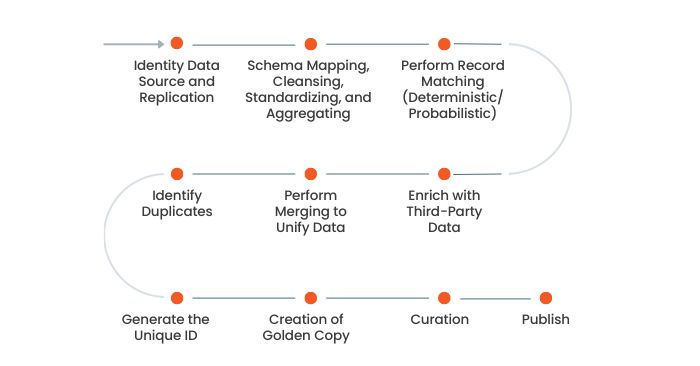
The result is an accurate and comprehensive 360-degree view of customer data, including preferences and behavior. This unified customer profile can then be communicated to stakeholders in the most engaging and relevant way—across marketing, sales, and service functions.
00
Identity and Entity Resolution
While identity resolution is often viewed as a marketing capability, its true impact emerges at the enterprise level—where unified identities become the foundation for consistent decisions, cross-system visibility, and trusted Customer 360 initiatives. This section explains data resolution at both marketing and enterprise levels.
Marketing Level Resolution
There are two types of resolving profile/customer identity:
B2C – Identity Resolution:
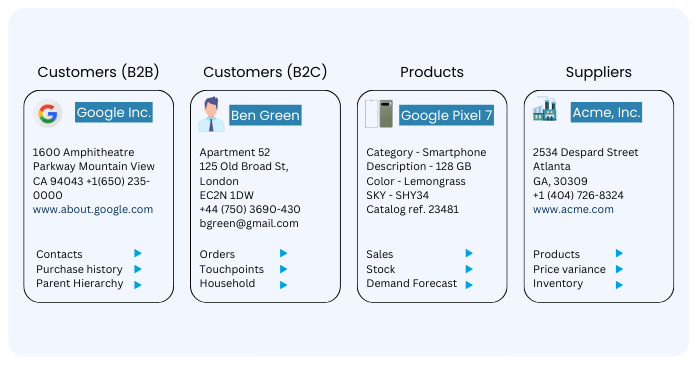
This involves identifying and unifying individual consumer profiles, ensuring all data points (e.g., email, phone number, purchase history) related to a single consumer are accurately linked.
B2B – Entity Resolution:
This focuses on identifying and unifying organizational profiles, ensuring all data points (e.g., company name, location, contact details) related to a single business entity are accurately linked.
Enterprise Level Resolution
There are three types of resolving profile/customer identity:
Customer records:
Integrating and deduplicating all customer information across the organization to provide a single, accurate profile for each customer, including their contact details, transaction history, and interactions.
Supplier records:
Consolidating supplier data to ensure that each supplier has a unified profile, encompassing their contact information, supply agreements, transaction history, and performance metrics.
Product records:
Standardizing and aggregating product information to maintain a consistent and comprehensive catalog of all products, including descriptions, specifications, pricing, and inventory levels.
Unifying these records enhances data accuracy, improves operational efficiency, and supports better decision-making across the enterprise.
00
Unlocking the Benefits of Identity Resolution
Deeper Customer Insights: By connecting data signals from multiple sources, marketers and enterprises can build robust customer profiles, enhancing campaign targeting, personalization, and relevance. This can encapsulate connected devices and information from ISPs (internet service providers).
Personalization Accuracy: Accurate identity resolution fuels personalized campaigns and interactions with customers by maintaining consistency of identifiers across systems.
Seamless Customer Experiences: Automated identity resolution enables a unified view of the customer journey, reducing duplicate contacts and enhancing interactions across channels.
Stronger Privacy Governance, Risk, and Compliance (GRC): Effective identity resolution supports data governance with privacy compliance and builds consumer trust. It simplifies preference management and ensures compliance with regulatory and corporate policies.
Enhanced Cross-Channel Attribution and Campaign Tracking:: Persistent IDs allow for accurate measurement and multi-touch attribution, improving the understanding of campaign effectiveness across different channels.
Improved Marketing ROI: Identity graphs reduce data overlap and duplication, making marketing spending more efficient.
Ultimately, identity resolution is not just a data technique—it is the mechanism that converts connected systems into connected truth.
00
Foster Better Customer Relationships with Identity Resolution
Identity Resolution is a powerful capability for building strong connections with each customer. By combining different pieces of information into one unified profile, organizations can create highly personalized experiences while maintaining privacy and trust.
When executed with the right architecture, engineering, and governance, identity resolution becomes the backbone of a scalable and trustworthy Customer 360 strategy. It is not just about engagement or ROI—it is about establishing a single, trusted customer identity that organizations can confidently activate across marketing, sales, and service.
At V2Solutions, we stay ahead of the technological curve by offering cutting-edge data management solutions. Our experts design tailored Identity Resolution systems that create unified customer profiles based on your specific needs, elevating customer engagement efforts to new heights.
Stitch Your Customer Data into One Identity
From deterministic and probabilistic matching to identity graphs, production-grade identity resolution requires robust data engineering pipelines. Learn how we design scalable identity resolution frameworks that deliver accurate, real-time customer profiles.
Agentic AI Development Services
AI, ML and Innovation
Application Development & Modernization
(AI)celerate Program
Your Agentic AI Isn’t Failing Because of the Model—It’s Failing Because of State
How Should CFOs Evaluate Agentic AI When the “Model” Isn’t the Product?
The Agentic AI Adoption Gap:
Why 88% Adopt But Only 6% Transform
The Real Barrier Isn’t Technology—It’s These Five Conversations You’re Not Having
Author’s Profile