
Mitigating Putback Risks Through
Technology and Process
Excellence
Understanding the Drivers, Impact, and Mitigation of Loan Putback Risk
Executive Summary
Mortgage lenders today operate in an environment defined by regulatory intensity, margin pressure, and increasing borrower complexity. Within this landscape, mortgage putback risk—where loans must be repurchased after being sold due to defects—continues to pose a material financial and operational challenge. What was once viewed primarily as a compliance issue has now evolved into a broader indicator of process maturity, data integrity, and underwriting discipline.
This whitepaper outlines a practical, technology-enabled approach to reducing putback risk. It explores the underlying causes of loan defects, examines how these defects translate into financial exposure, and presents a structured framework for improving loan quality across the lifecycle. The focus is not just on avoiding penalties, but on building a more resilient, efficient, and scalable mortgage operation.
00
Understanding Putback Risk in Today’s Mortgage Ecosystem
Mortgage putback risk originates from the contractual obligations between lenders and GSEs when loans are sold into the secondary market. These agreements require that loans meet strict underwriting, documentation, and compliance standards. If post-sale reviews uncover material defects—whether in borrower eligibility, income verification, or documentation accuracy—the GSE has the right to demand repurchase.
While the mechanics of putbacks are well understood, the drivers behind them have become more complex. Historically, defects were often linked to clear documentation gaps or underwriting errors. Today, they are increasingly tied to subtler issues such as data inconsistencies across systems, misinterpretation of evolving guidelines, or incomplete validation of borrower information.
A few recurring triggers continue to drive most repurchase demands:
- Income and employment verification gaps, especially with variable or non-traditional income
- Credit assessment inconsistencies due to fragmented or outdated borrower data
- Documentation errors, including missing disclosures or version mismatches
- Collateral valuation discrepancies stemming from appraisal or reporting issues
Income and employment verification, in particular, has emerged as one of the most persistent sources of defects. The rise of gig work, self-employment, and variable income streams makes it difficult to apply standardized verification processes. Similarly, credit assessment is no longer limited to traditional bureau data; lenders must increasingly interpret alternative data sources, which introduces new risks if not handled carefully.
Another contributing factor is the fragmentation of mortgage technology stacks. Many lenders operate with multiple systems that are not fully integrated, leading to duplicated data entry, inconsistent updates, and limited visibility across the loan lifecycle. These gaps create opportunities for errors that may not be detected until after the loan has been sold.
In essence, putback risk is no longer just about isolated mistakes—it reflects how well a lender’s entire operating model is aligned, from data capture to final delivery.
Evolution of Mortgage Putback Risk Landscape
Repurchase activity reached its apex between 2010 and 2015 due to heightened regulatory oversight and post-crisis mortgage reforms. Current data (2020-2023) indicates a resurgence in putback exposure, attributable to:
- Rising interest rate environments affecting loan affordability
- Increased reliance on non-traditional income verification
- Proliferation of complex loan structures, including ARMs and interest-only products
Economic Implications of Noncompliance and Buyback Events
Putback events carry profound financial implications across capital reserves, operational liquidity, and institutional profitability metrics.
Direct Financial Impact:
- Full Repurchase Obligation: Requirement to repurchase defective loans at original sale price, absorbing any market depreciation
- Servicing Burden: Ongoing loan administration costs that erode profitability margins
- Secondary Market Access Constraints – Potential suspension from GSE loan sales, limiting risk transfer capabilities
- Capital Reserve Requirements – Regulatory imperatives to maintain additional loss reserves against future repurchase exposure
Beyond quantifiable costs, significant indirect consequences include reputational damage, elevated risk premiums, and intensified regulatory scrutiny—factors that collectively diminish competitive positioning in securitization markets.
Correlation of Mortgage Putback Risk with Delinquency, Liquidity, and Operations
Putback exposure demonstrates strong correlation with delinquency patterns and liquidity constraints. Non-performing loans (NPLs) and early payment defaults (EPDs) frequently indicate underlying underwriting deficiencies. Substantial repurchase volumes constrain working capital, compromising lenders’ ability to:
- Sustain origination pipelines
- Maintain effective servicing operations
- Preserve preferential status in GSE programs
The 2020-2021 period saw elevated early default rates that prompted intensified scrutiny of self-employment income verification, necessitating more stringent underwriting protocols for non-traditional income documentation.
Key Risk Correlations:
- Loans with material underwriting defects exhibit 3.5x higher default probability
- Institutions experiencing significant putbacks face 20-30% increased liquidity pressure
- Servicing complexity escalates as lenders manage unanticipated high-risk assets
Effective risk mitigation requires implementation of early detection systems leveraging AI-driven analytics to identify potential defects before secondary market exposure. Proactive quality control and sophisticated risk assessment frameworks are essential for maintaining institutional stability and ensuring continued market participation.
00
The Financial and Operational Toll of Mortgage Putback Risk
The impact of loan putbacks extends far beyond the immediate cost of repurchasing a mortgage. At a fundamental level, lenders absorb the difference between the loan’s original sale price and its current market value, along with any associated penalties or fees. However, the broader financial implications are often far more significant.
Repurchased loans tie up capital that could otherwise support new originations, directly affecting revenue generation. Over time, recurring putbacks can strain liquidity, increase capital reserve requirements, and limit an organization’s ability to scale efficiently in a competitive market.
Operationally, the burden is equally substantial. Managing repurchases introduces additional layers of complexity, requiring teams to shift focus from core lending activities to remediation and compliance.
The ripple effects typically include:
- Increased workload for quality control, underwriting, and compliance teams
- Slower loan processing cycles due to repeated validations and rework
- Higher operational costs driven by manual reviews and escalations
- Reduced focus on strategic initiatives such as digital transformation or customer experience
Beyond financial and operational strain, there is a clear reputational risk. Persistently high defect rates can impact a lender’s credibility with investors and GSEs, leading to increased scrutiny and potential constraints on future loan sales. In a market where secondary access is critical, this can create a lasting competitive disadvantage.
Consider a mid-sized lender experiencing a rise in income verification defects. Even a modest increase in repurchase rates can translate into millions in unexpected costs within a single quarter. At the same time, internal teams must dedicate additional effort to audits and corrective actions, slowing down loan processing and affecting overall customer experience.
Key Drivers of Mortgage Putback Risk and Loan Defects
A closer examination of defect categories reveals where lenders are making progress and where challenges persist.
Asset verification has seen measurable improvement in recent years, largely due to the adoption of digital verification tools and standardized documentation practices. Automated systems can now validate account balances and flag inconsistencies more efficiently than manual processes. However, the growing use of non-traditional assets, such as digital currencies or complex investment portfolios, introduces new layers of complexity that require more advanced validation approaches.
Borrower eligibility has also benefited from automation, particularly through the integration of loan origination systems with underwriting engines. These integrations reduce the likelihood of misinterpreting eligibility criteria and enable more consistent decision-making. Yet, as guidelines evolve, maintaining alignment between systems and policy updates remains an ongoing challenge.
Credit assessment has become more reliable with direct integrations to credit bureaus and real-time monitoring of borrower profiles. Still, the increasing use of alternative credit data requires lenders to balance innovation with caution, ensuring that new data sources are interpreted accurately and consistently.
Income and employment verification continues to be the most significant source of defects. Traditional verification methods are often inadequate for today’s workforce, where income may come from multiple sources and fluctuate over time. Without robust validation mechanisms, lenders risk either overestimating borrower capacity or failing to detect discrepancies.
Documentation accuracy, while improved through digitization, is still vulnerable to errors, particularly when multiple versions of documents exist or when data must be transferred across systems. Even small inconsistencies can trigger compliance issues if not identified early.
Finally, regulatory compliance remains a moving target. While automation has reduced some risks, lenders must continuously adapt to changes in disclosure requirements, fair lending rules, and audit expectations. This requires not only technology but also a strong governance framework to ensure consistent interpretation and implementation.
00
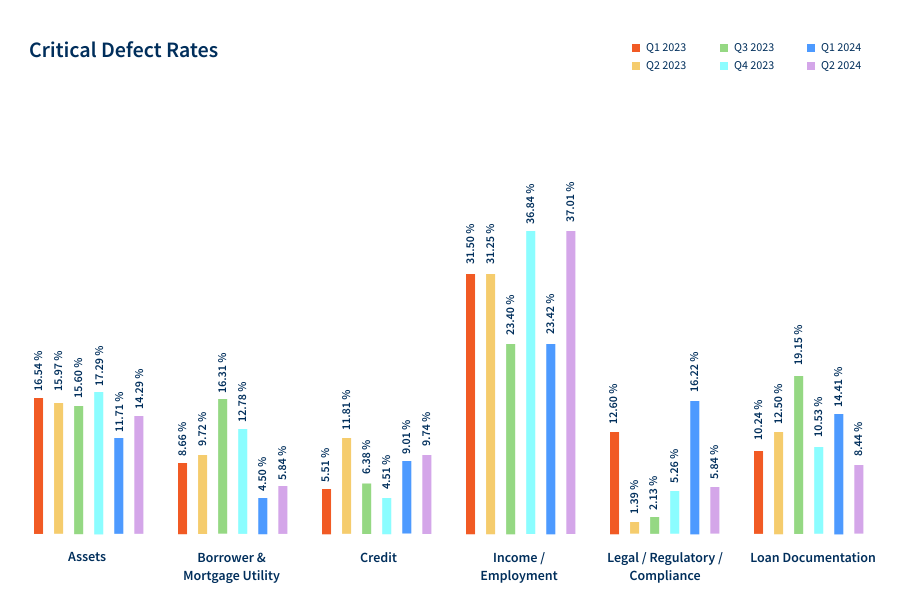
Quantifying Mortgage Putback Risk: Defect Categories and Performance Trends
Understanding putback risk requires a closer look at how defects are distributed across the loan lifecycle. While the industry has made measurable progress in several areas, improvements are uneven, and certain categories continue to expose lenders to disproportionate risk. The following analysis highlights where gains are being made and where attention is still urgently required.
Asset Verification: Steady Progress with Emerging Complexity
Asset documentation has shown gradual improvement, with defect rates declining from 16.5% in Q1 2023 to 14.29% in Q2 2024. This trend reflects the growing adoption of digital verification tools and more standardized validation practices across lending institutions.
Much of this progress can be attributed to a shift toward direct-source verification and automation. Lenders are increasingly relying on electronic account verification systems and intelligent data validation techniques to reduce manual errors and improve consistency.
However, this progress is not without its challenges. The nature of borrower assets is evolving, and verification processes are struggling to keep pace. Key pressure points include:
- Increasing use of non-traditional assets such as cryptocurrency and diversified investment portfolios
- Greater risk of digitally altered or manipulated financial documents
- Operational strain during high-volume periods, leading to reduced depth in verification
These factors indicate that while the foundation of asset verification is improving, lenders must continue strengthening controls—particularly for emerging asset classes that fall outside traditional validation frameworks.
Borrower Eligibility: A Model for Transformation
Borrower and mortgage eligibility has undergone one of the most significant transformations, with defect rates dropping sharply from 16.93% to 5.84% within a year. This improvement demonstrates what is possible when technology, process alignment, and governance are implemented cohesively.
The integration of loan origination systems with automated underwriting engines has reduced ambiguity in eligibility assessment and improved consistency across underwriting teams. Standardized interpretation of investor guidelines has further minimized variability in decision-making.
This category now serves as a benchmark for defect reduction across the mortgage lifecycle. However, sustaining this level of performance will depend on continuous alignment with evolving guidelines and proactive monitoring of edge cases that fall outside automated decision frameworks.
Credit Assessment: Consistency Through Automation
Credit-related defects have also declined significantly, falling from 6.35% to 1.74%, reflecting improved data integration and standardized evaluation processes. Direct connectivity with credit bureaus and automated discrepancy detection have reduced reliance on manual validation and minimized transcription errors.
Real-time monitoring of borrower credit profiles has added another layer of control, allowing lenders to capture late-breaking changes that could affect loan eligibility. These advancements have strengthened confidence in credit decisioning and reduced downstream risk.
At the same time, the credit landscape is becoming more complex. The inclusion of alternative data sources, such as rental and utility payments, introduces new opportunities but also new risks if not interpreted correctly. Maintaining consistency across these evolving data inputs will be critical to sustaining current gains.
Income and Employment Verification: The Critical Risk Concentration
Despite progress in other areas, income and employment verification remains the most significant and persistent source of defects. Defect rates have increased from 31.5% to 37.01%, making this category the single largest contributor to putback risk.
This trend reflects a fundamental shift in the nature of the workforce. Traditional verification models were designed for stable, salaried employment, but today’s borrowers often have multiple income streams, variable earnings, or non-traditional employment arrangements. These complexities make it difficult to apply standardized validation methods.
Several structural challenges continue to drive defects in this category:
- Limited ability to verify income for gig workers, freelancers, and self-employed borrowers
- Inconsistent documentation standards across employers and income types
- Increasing sophistication in income misrepresentation and document manipulation
- Lack of real-time or direct-source verification for many income streams
The impact of these challenges is significant. Because income verification directly influences a borrower’s ability to repay, defects in this area carry a higher probability of delinquency and repurchase. As a result, this category represents the largest opportunity for risk reduction, with the potential to lower overall putback exposure by an estimated 25–30% if addressed effectively.
Addressing this issue requires more than incremental improvements. Lenders must adopt advanced approaches such as AI-driven income analysis, direct integrations with payroll and financial data providers, and anomaly detection models that can identify inconsistencies across multiple data points. Without such interventions, income verification will continue to undermine broader quality control efforts.
Regulatory Compliance: Stabilization Through Discipline
Compliance-related defects have shown a steady decline, improving from 12.08% to 5.84%, indicating that lenders are becoming more effective at managing regulatory complexity. This progress reflects stronger governance frameworks, improved change management processes, and increased use of automated compliance checks.
Pre-funding validation has played a key role in identifying issues earlier in the loan lifecycle, reducing the likelihood of post-sale surprises. At the same time, investment in compliance expertise has enhanced the ability to interpret and apply regulatory requirements consistently.
However, the regulatory environment remains dynamic. New requirements, evolving interpretations, and increased scrutiny mean that compliance cannot be treated as a one-time achievement. Sustained success will depend on continuous monitoring, rapid adaptation, and deeper integration of compliance checks into core workflows.
Documentation Accuracy: Gains Driven by Digitization
Loan documentation accuracy has improved significantly, with defect rates declining from 19.15% to 8.44%. This progress is largely the result of digitization and automation across document management processes.
Technologies such as optical character recognition (OCR), automated completeness checks, and version control systems have reduced manual errors and improved consistency. These tools enable faster processing while ensuring that critical documentation requirements are met.
Despite these gains, documentation remains a foundational element of loan quality. Even minor inconsistencies can trigger compliance issues or repurchase demands if not identified early. As a result, lenders must continue investing in intelligent document processing and validation capabilities to maintain momentum.
00
The Role of Technology in Reducing Mortgage Putback Risk
Technology has become central to modern mortgage operations, but its effectiveness depends on how well it is integrated into the broader workflow. Isolated tools may address specific issues, but they rarely solve the underlying problem of fragmented processes.
One of the most impactful areas is the use of real-time validation during loan origination. By embedding checks at the point of data entry, lenders can prevent errors from propagating downstream. This approach shifts quality control from a reactive function to a preventive one, reducing the need for extensive post-close corrections.
Artificial intelligence is playing an increasingly important role, particularly in areas such as income verification and fraud detection. Machine learning models can analyze patterns across large datasets, identifying anomalies that would be difficult to detect manually. For example, AI can flag inconsistencies between reported income and historical earning patterns or detect signs of document manipulation.
Post-closing quality control has also evolved. Instead of relying solely on random sampling, lenders are adopting risk-based approaches that focus on loans with higher probability of defects. This improves efficiency while ensuring that critical issues are identified early.
Key technology capabilities that are driving measurable improvements include:
- Real-time data validation embedded within loan origination workflows
- AI-driven anomaly detection for income, assets, and documentation
- Integrated systems that ensure consistency across underwriting and compliance checks
- Advanced analytics for root cause identification and continuous improvement
Equally important is the ability to perform root cause analysis. Identifying a defect is only the first step; understanding why it occurred is essential for preventing recurrence. Advanced analytics can trace defects back to specific processes, teams, or system gaps, enabling targeted improvements.
However, technology alone is not sufficient. Its success depends on alignment with business processes, clear ownership of outcomes, and continuous monitoring to ensure that models and rules remain relevant.
00
Building Organizational Readiness to Mitigate Mortgage Putback Risk
Reducing putback risk requires more than process improvements—it demands a shift in how organizations approach quality. This begins with recognizing that loan quality is a shared responsibility across functions, rather than the sole domain of quality control teams.
Training and upskilling play a critical role. As technology becomes more sophisticated, employees must be equipped to interpret outputs, manage exceptions, and make informed decisions. This includes not only underwriters and compliance specialists but also front-line staff involved in data collection and customer interaction.
Governance structures are equally important. Clear accountability for loan quality, supported by cross-functional collaboration, ensures that issues are addressed holistically rather than in isolation. Regular review mechanisms, supported by data-driven insights, enable organizations to track progress and adjust strategies as needed.
Cultural alignment is often an overlooked factor. Organizations that prioritize speed over accuracy may inadvertently increase defect rates, while those that embed quality into their core values are better positioned to sustain improvements. Establishing a “right-first-time” mindset, supported by appropriate incentives and performance metrics, can significantly influence outcomes.
00
A Strategic Path Forward to Reduce Mortgage Putback Risk
The path to reducing putback risk lies in rethinking mortgage operations as an integrated, end-to-end process. Instead of addressing defects after they occur, lenders must focus on building systems and workflows that prevent them from arising in the first place.
A practical transformation approach typically involves three shifts:
- Moving from manual checks to automated, real-time validation
- Replacing fragmented systems with integrated data ecosystems
- Transitioning from reactive audits to predictive quality assurance
This involves creating a unified data environment where information flows seamlessly across systems, enabling consistent validation and real-time visibility. It also requires adopting predictive approaches that anticipate potential issues based on historical patterns and current inputs.
Over time, these capabilities can transform how lenders engage with the secondary market. Instead of reacting to audit findings, they can demonstrate consistent quality, build stronger relationships with investors, and operate with greater confidence and efficiency.
Importantly, this transformation does not need to happen all at once. Many lenders begin by targeting high-impact areas such as income verification or documentation accuracy, gradually expanding their efforts as they see measurable results. The key is to maintain a clear vision of the end state and ensure that each step contributes to that goal.
Conclusion
Putback risk is often viewed as an unavoidable aspect of mortgage lending, but in reality, it is a reflection of how effectively an organization manages its processes, data, and decisions. Lenders that continue to rely on fragmented systems and reactive controls will find it increasingly difficult to keep pace with evolving market demands.
On the other hand, those that invest in integrated technology, strengthen governance, and foster a culture of quality can significantly reduce defect rates and associated costs. More importantly, they can position themselves as reliable partners in the secondary market, gaining both operational and strategic advantages.
00
Are hidden defects already impacting your secondary market performance?
Move beyond reactive audits with intelligent automation, continuous monitoring, and end-to-end quality assurance.
Author’s Profile